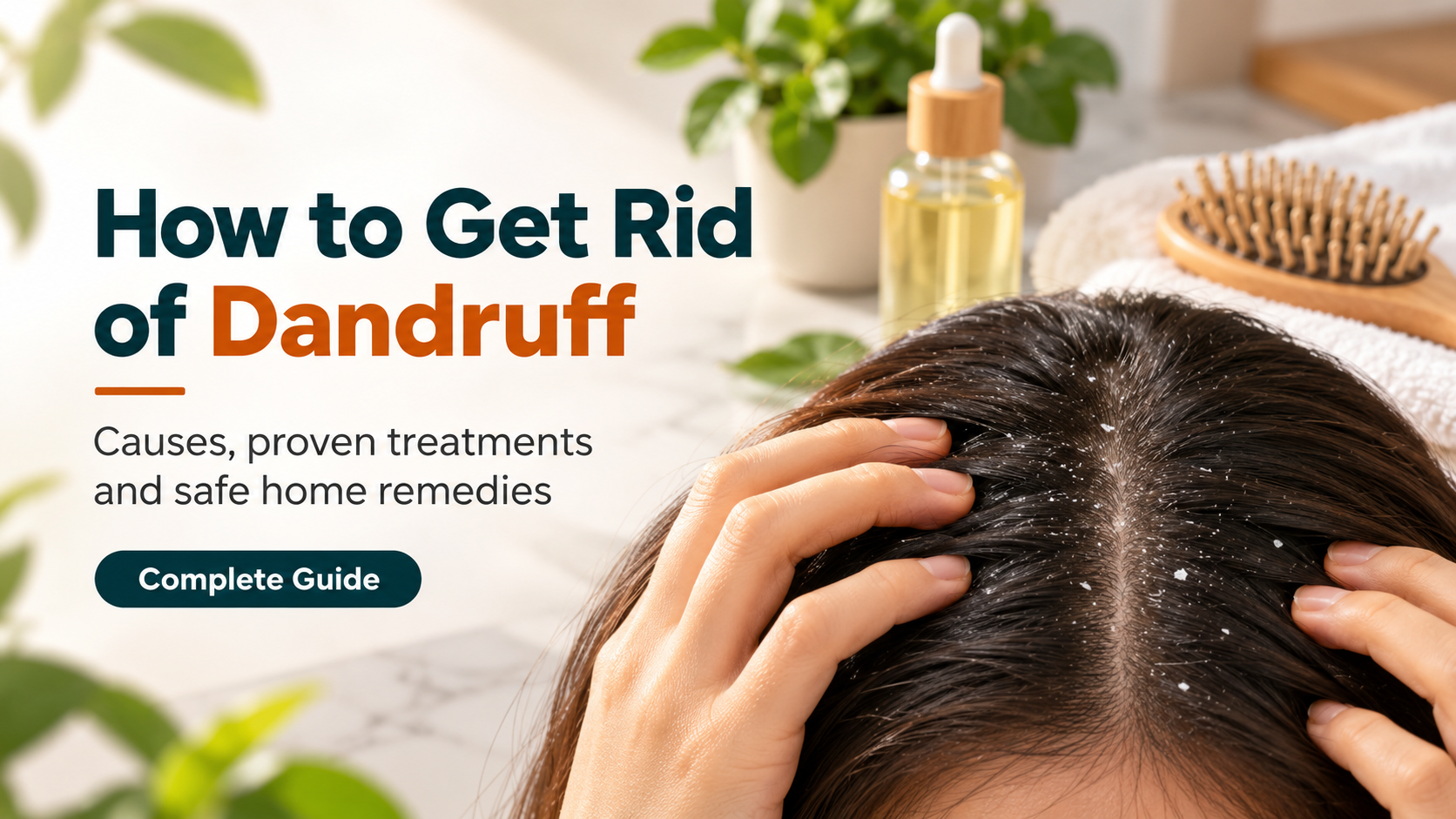

White flakes on your shoulders, an itchy scalp that never seems to settle, and the worry that everyone can see it. If that sounds familiar, you are in very good company. Dandruff is one of the most common scalp conditions in the world, and the good news is that it is almost always manageable once you understand what is driving it.
In this complete guide you will learn what dandruff really is, why it happens, which shampoo ingredients have solid evidence behind them, which home remedies are worth trying (and which to skip), and how to build a simple routine that keeps flakes under control. We will also cover when it is time to see a doctor.
Quick answer: how to get rid of dandruff
- Wash with a medicated anti-dandruff shampoo that contains zinc pyrithione, ketoconazole, selenium sulfide, salicylic acid or coal tar.
- Massage it into the scalp and leave it on for the time stated on the label (often 3 to 5 minutes) before rinsing.
- Use it consistently for 2 to 4 weeks, then reduce to once or twice a week to stay flake-free.
- Avoid scratching, heavy styling products and very hot water.
- See a doctor if there is no improvement after about 4 weeks, or if your scalp is red, sore, crusted or you are losing hair.
What Is Dandruff?
Dandruff is a common, harmless and non-contagious scalp condition that causes the skin on your head to flake. Your scalp, like the rest of your skin, constantly renews itself. Normally, old skin cells shed so quietly that you never notice. With dandruff, the process speeds up and the cells clump together, forming visible white or yellowish flakes that fall onto your hair and clothing.
Dandruff is often accompanied by itching. In its mild form it is simply flaking. In a more inflammatory form, called seborrheic dermatitis, the scalp can also look red and greasy and feel sore. Seborrheic dermatitis can appear on other oily areas of the body as well, such as the eyebrows, the sides of the nose and behind the ears.
It is important to know that dandruff has nothing to do with poor hygiene. Washing your hair does not cause it, and being “dirty” is not the reason you have it. It is a mix of your skin, the natural yeast on your scalp and how your body reacts to it.
What Causes Dandruff?
There is rarely a single cause. Dandruff usually results from a combination of factors, and understanding yours is the first step to choosing the right treatment.

1. Malassezia yeast
Almost every adult has a yeast called Malassezia living on the scalp. It feeds on the natural oils (sebum) your skin produces and leaves behind by-products that can irritate the scalp. In people who are sensitive to those by-products, the scalp becomes inflamed and sheds skin cells faster than normal. This yeast-driven reaction is considered the main driver of dandruff.
2. Seborrheic dermatitis
This is a more pronounced form of dandruff. The skin is oily, red and irritated, and the flakes tend to be larger and yellowish. It often comes and goes in cycles and can flare up in cold, dry weather or during stressful periods.
3. Dry skin
Cold winters, indoor heating, low humidity and long, very hot showers can strip moisture from your scalp. Dry-skin flakes are usually smaller and whiter, and the skin on other parts of your body often feels dry as well.
4. Sensitivity to hair products
Contact dermatitis is a reaction to something your scalp touches, such as hair dye, certain shampoos, gels, sprays or fragrances. It causes an itchy, red and flaky scalp, and the trigger can be hard to spot because the reaction may appear a day or two after exposure.
5. Not washing often enough
If you go too long between washes, oil and dead skin cells build up. That creates the perfect environment for yeast to thrive and for flakes to become more visible.
6. Stress, health and lifestyle
Stress, lack of sleep and an illness that affects the immune system can all make dandruff worse. Certain neurological conditions, such as Parkinson’s disease, are also linked with more frequent seborrheic dermatitis. Men are affected more often than women, and dandruff most often starts in adolescence and early adulthood, when oil production rises.
Dandruff vs Dry Scalp: How to Tell the Difference
Many people treat a dry scalp with oils and moisturizers when they actually have dandruff, and vice versa. Using the wrong approach is one of the most common reasons treatment fails. The comparison below can help you work out which one you are dealing with.

| Feature | Dandruff | Dry scalp |
|---|---|---|
| Flake size and color | Larger, oily, white or yellowish | Smaller, dry and powdery white |
| Scalp feel | Oily, may look red or irritated | Tight, dry, no visible oiliness |
| Itching | Common and persistent | Usually mild |
| Rest of the body | Usually normal skin | Often dry skin on arms and legs |
| Best approach | Medicated anti-dandruff shampoo | Gentle shampoo and moisturizing care |
A simple test: if your hair gets greasy quickly and the flakes look oily and clump together, dandruff is the more likely culprit. If your scalp feels tight and your skin is dry all over, especially in winter, a dry scalp is more likely. You can also have both at once.
How to Get Rid of Dandruff: Proven Treatments
For most people, the most effective step is a medicated anti-dandruff shampoo. These products work in different ways: some reduce the yeast on your scalp, some slow down how quickly skin cells are produced, and some loosen existing flakes so they rinse away.
The 5 key anti-dandruff shampoo ingredients

- Zinc pyrithione: An antifungal and antibacterial ingredient that reduces the yeast on your scalp. It is gentle enough for frequent use and is the active ingredient in many everyday dandruff shampoos.
- Ketoconazole: A powerful antifungal that targets Malassezia directly. Lower-strength versions are available without a prescription in many countries, and it is commonly used about twice a week. Stronger formulas require a prescription.
- Selenium sulfide: Slows the turnover of skin cells and helps control yeast. It can discolor light, gray or color-treated hair, so rinse thoroughly.
- Salicylic acid: A keratolytic that softens and lifts scale so it can be rinsed away. It can leave the scalp feeling dry, so follow with a conditioner on the lengths of your hair.
- Coal tar: Slows the rate at which scalp cells die and flake off. It has a strong smell, can stain light hair and may make the scalp more sensitive to sunlight.
If you have tried one ingredient for a few weeks without success, switch to a different one. Some people find that alternating two shampoos with different active ingredients keeps results steady, because the scalp can seem to “get used to” a single product over time.
How to use anti-dandruff shampoo correctly
Even the best shampoo will disappoint if it is used the wrong way. The most common mistake is rinsing it off too quickly. The active ingredient needs time in contact with your scalp to work.

- Wet your hair and scalp thoroughly with lukewarm water. Very hot water can dry and irritate the skin.
- Apply the shampoo to your scalp, not just the lengths of your hair. The scalp is where the problem lives.
- Massage gently with your fingertips for one to two minutes. Avoid scratching with your nails, which can break the skin and make irritation worse.
- Leave it on for the time recommended on the label, which is often 3 to 5 minutes.
- Rinse thoroughly, then apply conditioner to the mid-lengths and ends only, keeping it off the scalp.
How often should you wash?
When you start, use your medicated shampoo two to three times a week for the first two to four weeks, or as directed on the packaging. Once flakes are under control, many people can drop to once a week for maintenance. On the other days, use a gentle regular shampoo. If you have oily hair, you may need to wash more often; if your hair is very curly or dry, you can space washes further apart while still applying the medicated shampoo to the scalp on wash days.
Be patient: how long does it take to work?
Expect to see a noticeable improvement within about two to four weeks of regular use. Dandruff is a chronic, recurring condition for many people, so the goal is usually to control it rather than cure it permanently. If flakes return when you stop treatment, that is normal and not a sign that the shampoo has failed. Simply go back to using it regularly.
Prescription options
If over-the-counter shampoos are not enough, a doctor or dermatologist may suggest stronger antifungal shampoos, a short course of a topical corticosteroid to calm inflammation, or other prescription treatments. These are especially helpful for seborrheic dermatitis. Always use them as directed, since long-term steroid use on the scalp is not recommended without medical advice.
Home Remedies for Dandruff: What Works and What to Avoid
Home remedies are popular, but the evidence behind them varies a lot, and some can actually make dandruff worse. Natural does not always mean gentle. Here is an honest look at the most common options.

Tea tree oil
Tea tree oil has natural antifungal properties, and a small clinical trial found that a shampoo containing about 5% tea tree oil improved dandruff over several weeks. Never apply pure tea tree oil to the scalp, because it can cause burning and allergic reactions. Choose a shampoo that already contains it in a safe, diluted amount, and stop using it if you notice redness or itching.
Aloe vera
Aloe vera gel is soothing and may calm an irritated scalp, but there is limited proof that it treats the underlying cause. It makes a pleasant addition to a routine rather than a standalone solution.
Neem
Neem is widely used in traditional hair care for its antifungal and antibacterial reputation. Research in people is limited, so treat it as a gentle supporting option and do a patch test on your skin first.
Apple cider vinegar
Many people rinse with diluted apple cider vinegar, hoping to rebalance the scalp. Scientific support is weak, and undiluted vinegar can sting and irritate. If you try it, dilute it generously with water, use it only occasionally and stop if your scalp feels sore.
Coconut oil
Coconut oil can soften dry, flaky skin, which may help if you have a dry scalp. However, Malassezia yeast feeds on certain oils, so heavy oils can make true, oily dandruff worse. If your scalp is already oily, it is best to skip it.
Baking soda and lemon juice
These are widely shared online but are not recommended. Baking soda is alkaline and can disrupt the natural balance of your skin, while lemon juice is acidic and can cause irritation and increased sensitivity to the sun. The risks outweigh any possible benefit.
Always patch test first
Before applying any new product or home remedy to your scalp, test a small amount on the inside of your forearm and wait 24 hours. If you notice redness, itching or swelling, do not use it on your scalp.
Lifestyle Habits That Help Prevent Dandruff
Treatment gets flakes under control, but daily habits help keep them away. These simple changes make a real difference over time.
- Manage stress. Regular exercise, enough sleep, and relaxation practices such as walking or breathing exercises can reduce flare-ups.
- Eat a balanced diet. Zinc, B vitamins and healthy fats support skin health. There is no magic dandruff diet, but a poor, restricted diet can make skin problems worse.
- Get some fresh air. Spending time outdoors is good for overall wellbeing. Do not rely on sun exposure to treat dandruff, as too much ultraviolet light damages skin.
- Go easy on styling products. Gels, sprays and waxes can build up on the scalp and irritate it. Rinse them out regularly.
- Lower the water temperature. Lukewarm water is kinder to your scalp than very hot showers.
- Keep your tools clean. Wash combs, brushes and pillowcases regularly so oil and flakes do not build up and transfer back to your hair.
- Protect your scalp in winter. Cover your head outdoors to avoid cold wind, and consider a humidifier if indoor air is very dry.
- Do not scratch. It can injure the skin, cause infection and make flaking worse.
How to Choose the Right Anti-Dandruff Shampoo
With so many products on the shelf, picking one can feel overwhelming. Use the guide below to match a shampoo to your scalp and hair type.
| Your situation | What to look for |
|---|---|
| Mild, occasional flakes | Zinc pyrithione shampoo used a few times a week |
| Persistent, itchy, oily flakes | Ketoconazole or selenium sulfide shampoo |
| Thick, stubborn scale | Salicylic acid or coal tar shampoo |
| Sensitive scalp | Fragrance-free, sulfate-free formula with a gentle active ingredient |
| Color-treated or gray hair | Zinc pyrithione or ketoconazole; be cautious with selenium sulfide and coal tar, which can discolor |
| Dry or curly hair | Hydrating formula plus a conditioner on the lengths after each wash |
What to check before you buy
- The active ingredient. It should be listed clearly on the label. A product that only says “anti-dandruff” in large letters may not contain a proven ingredient.
- Your scalp and hair type. Oily, dry, curly, fine and color-treated hair all have different needs.
- Fragrance and irritants. If your scalp is easily irritated, choose a fragrance-free option.
- Directions for use. Look for clear instructions about how often to use it and how long to leave it on.
- Value. Price does not always reflect quality. A budget shampoo with the right active ingredient can work as well as an expensive one.
Common Dandruff Myths
- Myth: Dandruff is caused by dirty hair. Fact: It is not about cleanliness. It is linked to yeast, oil and your skin’s reaction.
- Myth: Dandruff is contagious. Fact: You cannot catch it from someone else or pass it on.
- Myth: Washing too often causes dandruff. Fact: Regular washing helps control flakes, particularly with oily hair.
- Myth: Dandruff causes hair loss. Fact: It does not directly, though heavy scratching and inflammation can damage hair and the scalp.
- Myth: Once cured, it never returns. Fact: Dandruff is usually a long-term condition that can be controlled but often comes back without maintenance.
When to See a Doctor
Mild dandruff is almost always safe to manage at home, but some symptoms need medical attention because they may point to another condition, such as psoriasis, eczema, a fungal infection like ringworm of the scalp, or a skin allergy.
See a doctor or dermatologist if:
- Your dandruff has not improved after about four weeks of consistent treatment.
- Your scalp is very red, swollen, painful or has oozing or crusted areas.
- You have thick, silvery or greasy patches that spread beyond the scalp.
- You notice patchy hair loss or broken hair in the affected area.
- The itching is severe or disrupts your sleep.
- Your baby or young child has thick crusts on the scalp. This is often cradle cap, which is different and should be checked by a pediatrician.
Frequently Asked Questions
Can dandruff be cured permanently?
For most people, dandruff is a long-term condition that can be controlled very well but not permanently cured. Regular maintenance with the right shampoo usually keeps flakes away.
How can I get rid of dandruff fast?
Use a medicated shampoo with a proven active ingredient, leave it on the scalp for the full recommended time, and use it consistently. Most people see improvement in two to four weeks. No treatment removes dandruff overnight.
Does dandruff go away on its own?
Mild cases may improve with better washing habits and changes in weather, but persistent dandruff rarely disappears without treatment.
Is it okay to use anti-dandruff shampoo every day?
Some formulas, such as those with zinc pyrithione, are designed for frequent use. Others, like ketoconazole or coal tar, are usually used a couple of times a week. Always follow the directions on the label.
Can anti-dandruff shampoo make my hair dry?
Some ingredients can leave hair feeling dry. Apply the shampoo to the scalp only and use a conditioner on the mid-lengths and ends after rinsing.
Does diet affect dandruff?
Diet is not a direct cause, but a balanced diet with enough zinc, B vitamins and healthy fats supports healthy skin and may help reduce flare-ups.
Final Thoughts
Dandruff can be frustrating, but it is common, treatable and nothing to be embarrassed about. The most reliable path is simple: identify whether you have dandruff or a dry scalp, choose a shampoo with a proven active ingredient, use it correctly and consistently, and support your scalp with gentle habits. Be cautious with home remedies, patch test anything new, and do not hesitate to see a doctor if your symptoms are severe or do not improve.
With a little patience and the right routine, you can say goodbye to flakes and enjoy a calm, comfortable scalp.
Disclaimer: This article is for general information only and is not a substitute for professional medical advice, diagnosis or treatment. Always consult a qualified healthcare provider about any scalp or skin concern.