








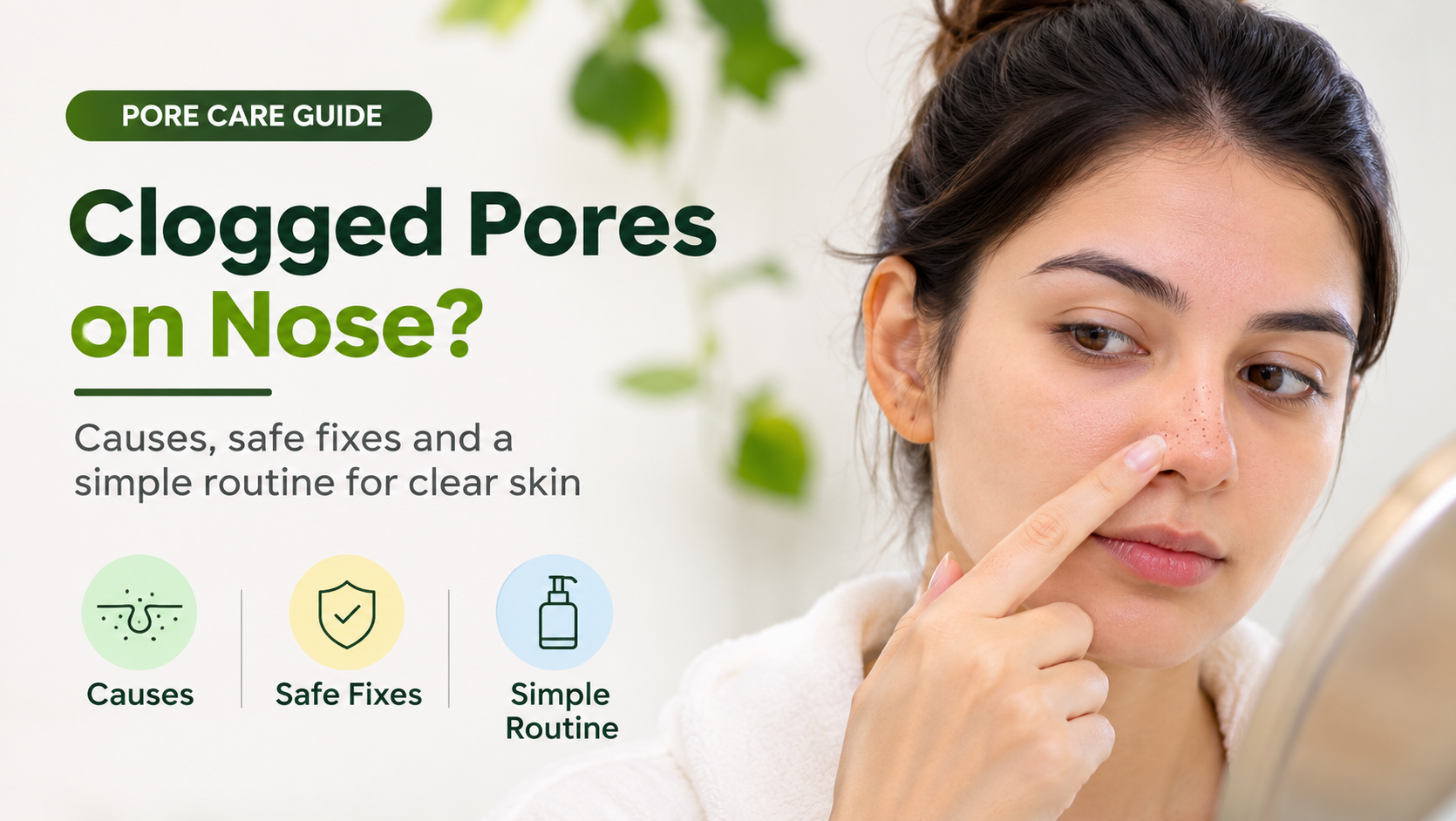
Many people notice tiny dark dots, rough texture or a shiny, congested look across the nose. If you are dealing with clogged pores on your nose, you are in very good company. The nose is one of the most common places for blackheads and congestion, and the good news is that it can be managed with the right routine.
In this guide you will learn what causes clogged nose pores, how blackheads differ from sebaceous filaments, which ingredients help, which popular tricks to avoid, a simple daily routine and when to get professional help.
Quick Answer
Clogged pores on the nose are caused by oil, dead skin cells, many oil glands, pore-clogging products, leftover sunscreen or makeup, sweat, hormones and picking. Cleanse gently, remove sunscreen and makeup thoroughly, use a BHA (salicylic acid) or retinoid slowly and consistently, and avoid squeezing or harsh scrubbing.
Medical Note
This article is for general information and is not medical advice. If your skin is painful, inflamed or not improving, speak to a dermatologist or healthcare professional.
Table of Contents
- What are clogged pores?
- 8 causes of clogged pores on the nose
- Blackheads, whiteheads or sebaceous filaments?
- How to clear clogged nose pores safely
- Ingredients and treatments that help
- Methods to avoid
- A simple routine
- Lifestyle habits that help
- When to see a dermatologist
- Frequently asked questions
What Are Clogged Pores?
Pores are the openings of hair follicles. Each follicle has an oil gland that releases sebum, which keeps skin soft and protected. A pore becomes clogged when sebum, dead skin cells and debris form a plug inside it. If the top of the plug stays open, it can darken and become a blackhead. If the pore closes over the plug, it forms a whitehead.
8 Causes of Clogged Pores on the Nose
Cause 1: A high number of oil glands
The nose and the T-zone naturally contain many sebaceous glands, which make oil to keep skin soft. When those glands are active, oil can mix with dead skin cells and form a plug inside the pore.
What helps:
- Cleanse gently twice a day.
- Choose lightweight, oil-free or non-comedogenic moisturizers.
- Be patient, since oil production is partly genetic and cannot be switched off.
Cause 2: Excess oil (sebum) production
Hormonal changes, genetics, heat, humidity and stress can increase oil production. More oil gives dead cells more material to bind with.
What helps:
- Use a BHA or retinoid to help keep pores clear.
- Keep a consistent routine rather than changing products often.
- Speak to a doctor if breakouts are severe or linked to hormonal changes.
Cause 3: Dead skin cell build-up
Skin renews itself constantly. If dead cells are not shed efficiently, they can pile up inside pores and trap oil.
What helps:
- Use a leave-on exfoliant such as salicylic acid a few times a week.
- Avoid over-scrubbing, which can irritate skin.
- Add a retinoid like adapalene gradually if recommended for you.
Cause 4: Pore-clogging products
Heavy creams, rich balms and some makeup or sunscreens can sit in pores and contribute to blackheads and whiteheads, especially in people who are prone to them.
What helps:
- Look for non-comedogenic and oil-free labels as a helpful hint.
- Introduce one new product at a time and watch your skin.
- Apply a thin layer of moisturizer rather than a thick coat.
Cause 5: Sunscreen and makeup not fully removed
Residue that stays on the nose overnight can mix with oil and debris. This is a very common reason for stubborn blackheads.
What helps:
- Remove sunscreen and makeup every evening, using an oil or balm cleanser if you wear water-resistant products.
- Follow with a gentle water-based cleanser (double cleansing).
- Pay attention to the creases at the sides of the nose.
Cause 6: Sweat, humidity and pollution
Sweat and city dirt mix with oil and can add to blockages. Hot, humid weather often makes noses look shinier and more congested.
What helps:
- Wash your face after heavy sweating or exercise.
- Carry oil-control or gentle wipes if you are active outdoors.
- Wash pillowcases and hats regularly.
Cause 7: Over-washing and over-scrubbing
Using strong cleansers or scrubs too often can strip the skin and trigger more oil production and irritation. Rough scrubbing also does not remove plugs from deep inside the pore.
What helps:
- Limit cleansing to twice a day.
- Use a mild, fragrance-free cleanser.
- Exfoliate with a chemical exfoliant instead of a gritty scrub.
Cause 8: Touching, picking and squeezing
Hands carry oil and bacteria. Picking can push debris deeper, enlarge pores and cause scars or dark marks.
What helps:
- Keep hands off your nose, and avoid resting your face on your hands.
- Never squeeze blackheads at home with force.
- If you need extractions, see a trained professional.
Blackheads, Whiteheads or Sebaceous Filaments?
Not every dot on the nose is a clogged pore. Many people are actually seeing sebaceous filaments, which are a normal part of skin. Telling them apart prevents unnecessary scrubbing and over-treatment.
| Feature | Blackheads | Sebaceous filaments |
|---|---|---|
| Color | Dark brown or black | Tan, gray or yellowish |
| Texture | Raised or flat plug that feels firm | Flat, tiny, hair-like thread under the surface |
| Pattern | Scattered, can vary in size | Evenly spaced, uniform, often in clusters on the nose and chin |
| What they are | Clogged pores that need clearing | Natural channels that carry oil to the skin surface |
| Come back? | Yes, if the cause is not addressed | Yes, usually within about a month, since they are normal |
| Best approach | Regular BHA or retinoid use and gentle cleansing | Keep them tidy with BHA and leave them alone |
Good to Know
Sebaceous filaments will usually return within weeks even after you clear them, because they are the normal channels that carry oil to the surface. Managing them is about keeping them tidy, not eliminating them.
How to Clear Clogged Nose Pores Safely
- Cleanse gently twice a day with a mild, fragrance-free cleanser, and a few seconds extra around the nose.
- Double cleanse in the evening if you wear sunscreen or makeup, starting with an oil or balm cleanser.
- Add a BHA such as salicylic acid 2-4 times a week, increasing as your skin tolerates it.
- Consider a retinoid such as adapalene at night, introduced slowly, to help pores stay clear.
- Use a lightweight moisturizer so that skin does not become dry and produce more oil.
- Protect with sunscreen every day, since sun damage can make pores look larger.
- Be patient. Pores take 4-8 weeks to show real improvement.
Ingredients and Treatments That Help
| Option | How it helps | Good to know |
|---|---|---|
| Salicylic acid (BHA, 0.5-2%) | Oil-soluble, so it can work inside pores to loosen the plug | Start a few times a week; can dry the skin |
| Adapalene (retinoid) | Helps skin cells shed normally so pores do not clog | Start slowly at night; avoid in pregnancy unless a doctor advises |
| Azelaic acid | Helps keep pores clear and calms redness | Can tingle at first; suits sensitive skin |
| Niacinamide | May help with oil appearance and pore look | Generally well tolerated |
| Clay mask (kaolin, bentonite) | Absorbs surface oil temporarily | Once a week is enough; do not leave to dry fully |
| Oil or balm cleanser | Dissolves sebum, sunscreen and makeup | Rinse well, follow with a gentle cleanser if needed |
| Professional extraction or peels | Clears stubborn plugs safely | Done by a trained skin professional, not at home |
Safety Tip
Do not start several strong actives at the same time. Introduce one at a time, patch test, and stop if you feel burning, swelling or severe dryness. Ask a doctor or pharmacist if you are pregnant, breastfeeding or have sensitive skin.
Methods to Avoid or Use With Caution
| Method | Verdict | Why |
|---|---|---|
| Pore strips | Use rarely, if at all | Remove the top of some plugs, but can irritate skin and results are short-lived |
| Squeezing with fingers | Avoid | Can cause scars, dark marks and infection |
| Metal extractor tools at home | Avoid unless trained | Easy to bruise and damage skin |
| Toothpaste, baking soda, lemon juice | Avoid | Can burn and irritate the skin |
| Harsh scrubs | Avoid | Do not unclog pores and can worsen irritation |
| Steam or warm cloth before cleansing | Helpful | Softens the surface before gentle cleansing |
A Simple Routine for Clogged Nose Pores
You do not need a complicated routine. Consistency matters more than the number of products.
Lifestyle Habits That Help
- Wash pillowcases weekly and clean makeup brushes and phone screens regularly.
- Keep your hands away from your face.
- Choose non-comedogenic makeup and sunscreen and always remove them at night.
- Cleanse after sweating rather than letting sweat dry on the skin.
- Be realistic. Some visible pores and filaments are normal and cannot be completely removed.
Choosing Products for Nose-Prone Skin
When you shop for cleansers, exfoliants, moisturizers and sunscreens, these features are worth checking.
- Gentle cleansers that are fragrance-free and not stripping.
- BHA products in a leave-on gel, liquid or lotion rather than a rinse-off scrub.
- Lightweight moisturizers labelled oil-free or non-comedogenic.
- Oil or balm cleansers that rinse cleanly if you wear water-resistant sunscreen or makeup.
- Sunscreens with a light, fluid texture that do not feel heavy on oily skin.
- Clear ingredient lists so you can track what helps or irritates your skin.
When to See a Dermatologist
- Painful, red or inflamed bumps, or cysts.
- Signs of infection such as swelling, warmth or pus.
- No improvement after 8-12 weeks of consistent routine care.
- Scarring or dark marks from previous breakouts.
- Uncertainty about whether bumps are clogged pores or another skin condition.
- Wanting professional extractions, peels or prescription treatments.
Frequently Asked Questions
What causes clogged pores on the nose?
Mainly oil and dead skin cells that collect in pores, in an area with many oil glands. Pore-clogging products, leftover sunscreen or makeup, hormones, sweat and genetics can all contribute.
Are the black dots on my nose dirt?
No. Blackheads are dark because the oil and skin cells in an open pore are exposed to air and oxidize. Scrubbing harder does not remove them and can irritate skin.
Are these blackheads or sebaceous filaments?
Blackheads are dark and raised or firm plugs, while sebaceous filaments are tan or gray, flat and evenly spaced. Filaments are normal and fill back up within weeks.
Do pore strips really work?
They can lift the top of some plugs, but the effect is short-lived and they can irritate skin. They do not fix the underlying cause, so they are best used rarely or avoided.
Can I shrink my pores?
Pore size is largely genetic, but keeping them clear of oil and debris, using sunscreen and using ingredients such as BHA, retinoids and niacinamide can make them look smaller.
How long does it take to see results?
Most people see improvement after about 4-8 weeks of consistent use. Start slowly, as active ingredients can cause dryness and flaking at first.
Is it safe to use a retinoid or salicylic acid in pregnancy?
Not everyone can use them. Ask a doctor or pharmacist before using retinoids or other acne actives if you are pregnant, breastfeeding or planning pregnancy.
When should I see a dermatologist?
See one if bumps are painful, inflamed, scarring or spreading, if there is no improvement after 8-12 weeks of consistent care, or if you are unsure what the bumps are.
Final Thoughts
Clogged pores on the nose are common, normal and manageable. They come from a combination of oil, dead skin cells, products and habits, and they respond best to gentle consistency rather than aggressive tricks. Cleanse properly, remove sunscreen and makeup, add a BHA or retinoid slowly and resist the urge to squeeze.
Keep expectations realistic, since some visible pores and filaments are completely normal. If your skin is inflamed, painful or does not improve, a dermatologist can offer safe, tailored treatments.