




Skin Purging vs Breakout: How to Tell the Difference
A new product, new pimples and a big question: should you keep going or stop?
You start a promising new retinol, acid or acne treatment, and a few weeks later your skin looks worse than before. Is it skin purging, a temporary adjustment that will pass, or a plain old breakout caused by the product or something else?
It is a common and stressful question, because the two can look almost identical. In this guide you will learn what skin purging is, how it differs from a regular breakout and from an irritant reaction, how long it typically lasts, a simple self-check to help you decide, what to do in each case and when to speak to a doctor.
Please note
This article is for general education and is not medical advice or a diagnosis. Skin reactions vary, and some can be serious. If you have burning, swelling, hives, severe pain, signs of infection or you are unsure, stop the product and speak to a doctor or dermatologist.
In this guide
- Quick answer
- What is skin purging?
- What is a breakout?
- Purging vs breakout vs reaction
- How long purging lasts
- A quick self-check
- Products linked to purging
- What to do during a purge
- What to do if it is not purging
- How to avoid purging
- When to see a doctor
- Frequently asked questions
Quick Answer
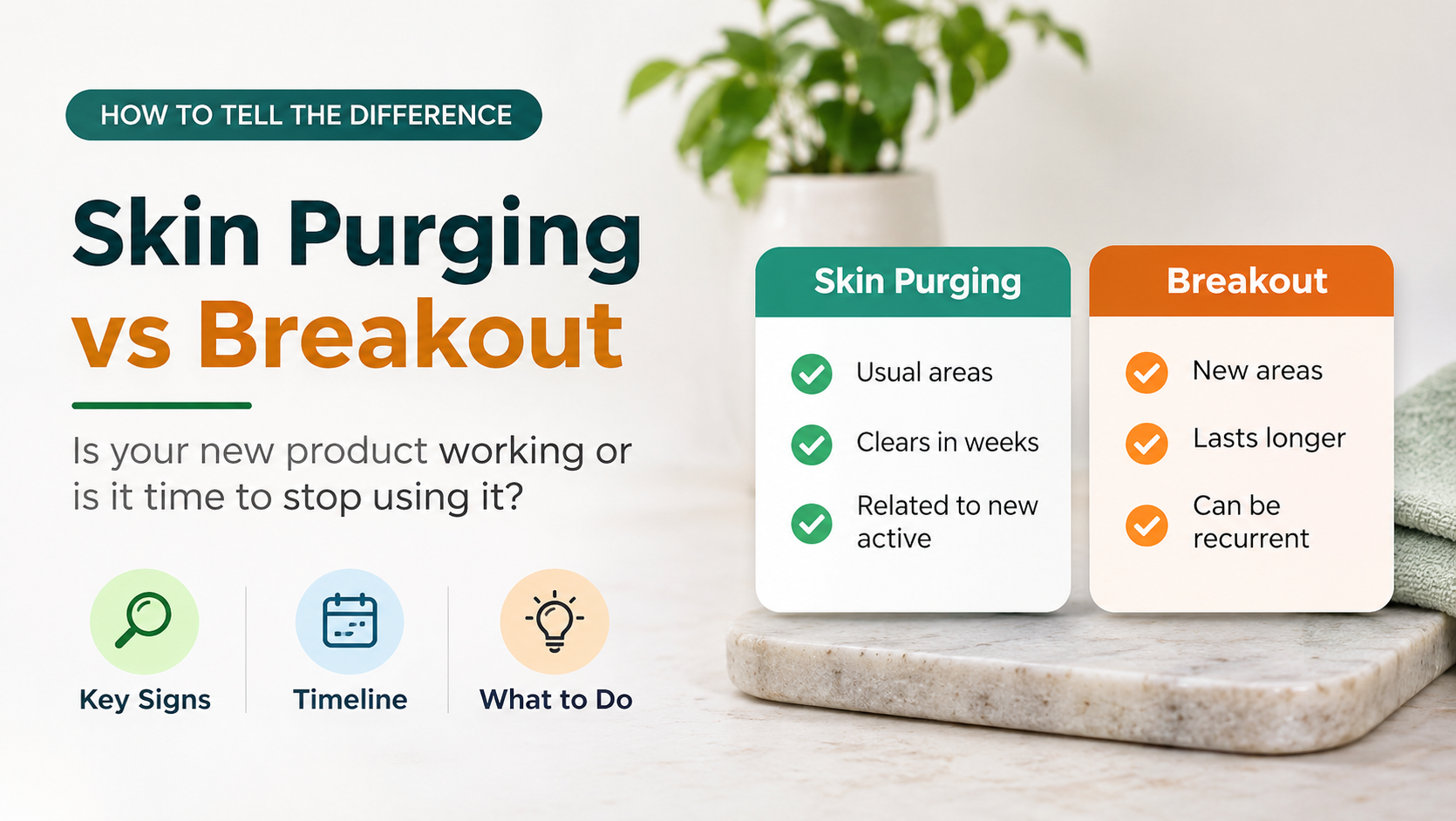
Skin purging is a temporary flare of small pimples that appears in your usual breakout areas soon after starting a retinoid or exfoliating active, and it typically settles within about four to six weeks. A breakout can appear anywhere at any time, may include deeper or longer-lasting spots and does not improve on its own or gets worse. Burning, itching, swelling or a rash points to a product reaction, not purging.
What Is Skin Purging?
Acne starts deep inside the pore, often weeks before a pimple appears. Tiny clogs called microcomedones form slowly and gradually rise toward the surface. Ingredients that speed up skin cell turnover, such as retinoids and exfoliating acids, push this process into fast-forward. The result can be a wave of small bumps appearing at once, even though they were already on their way.
Purging often looks like small whiteheads, blackheads and little red bumps, sometimes with mild dryness or flaking, in places where you typically get pimples. It tends to ease as the skin adjusts and the clogged pores clear out.
A note on the science
Purging is widely described by dermatologists, but research that directly measures it is limited, and some experts see it as a mix of an early flare and mild irritation. Treat the term as a helpful guide, not a guarantee, and judge by what your skin actually does.
What Is a Regular Breakout?
A regular breakout is acne that happens for reasons unrelated to a recent change in turnover-boosting ingredients. Common causes include hormones, excess oil, genetics, stress, pore-clogging products, friction, sweat and diet. Breakouts can happen with or without any new product, can include deep, tender cysts and tend to continue unless something changes.
Skin Purging vs Breakout vs Product Reaction
| Feature | Skin purging | Regular breakout | Product reaction |
|---|---|---|---|
| What triggered it | A new retinoid or exfoliating active | Hormones, oil, stress, clogging products, friction or no clear trigger | A product or ingredient your skin does not tolerate |
| Where it appears | Areas where you usually break out | Anywhere, including new areas | Where the product touches the skin |
| How long it lasts | Typically a few weeks, usually settling by about six | Continues or keeps recurring | Worsens or does not settle |
| What it looks like | Small bumps, whiteheads, blackheads, some dryness | Any type, including deep painful cysts | Burning, stinging, itching, swelling, rash or hives |
| What to do | Be gentle and patient; ease up on the active | Review triggers; try suitable treatments | Stop the product and seek advice |
How Long Does Skin Purging Last?
Many dermatologists describe purging as lasting about four to six weeks, roughly the time it takes for the skin to complete a renewal cycle. Some guidance for retinoids allows two to eight weeks, with improvement often noticed from about six weeks onward. Because individual lesions also come and go, you should see spots clearing faster than a normal breakout and fewer new ones forming as the weeks pass.
If your skin is getting worse instead of better, if breakouts last well beyond six weeks or if new areas are involved, the product may not be right for you, or something else is going on.
A Quick Self-Check
Answer these four questions to get a sense of what is happening. This is not a diagnosis, but it can help you decide what to do next.
Products Linked to Skin Purging
| Product type | What it does | Purging notes |
|---|---|---|
| Retinoids (tretinoin, adapalene, retinol) | Speed up cell turnover | Most commonly linked to purging |
| Alpha hydroxy acids (glycolic, lactic) | Exfoliate the skin surface | Can cause a temporary flare in some people |
| Beta hydroxy acid (salicylic acid) | Unclogs pores and exfoliates | May cause short-term flaking or bumps |
| Benzoyl peroxide | Reduces acne bacteria and inflammation | Mainly causes dryness; some report an initial flare |
| Chemical peels and exfoliating tools | Remove surface layers | Overuse can irritate rather than purge |
| Moisturizers, oils, makeup and sunscreens | Hydrate or protect | Not expected to purge; new pimples suggest clogging or irritation |
What to Do If You Think It Is Purging
- Do not stop abruptly out of panic. If your skin is only mildly flared and not painful, many people continue gently.
- Reduce frequency. Use the active every second or third night instead of nightly.
- Moisturize well. A simple, non-comedogenic moisturizer helps with dryness and flaking.
- Use sunscreen every day. Retinoids and exfoliating acids can make skin more sun-sensitive.
- Keep the rest of your routine simple. Pause other strong actives such as extra acids or scrubs.
- Never pick or pop. It can cause scars and dark marks.
- Take photos in the same light. They help you see real progress over weeks.
- Set a check-in date. If there is no improvement around six weeks, reassess.
What to Do If It Is Not Purging
- Stop the new product if you have burning, intense stinging, swelling, hives or a rash.
- Return to a gentle routine with a mild cleanser, moisturizer and sunscreen until your skin calms down.
- Look for clogging products. Check makeup, sunscreen, hair products and moisturizers.
- Review other triggers such as friction, hormones, stress and sleep.
- Talk to a professional for persistent, painful or widespread acne, and about suitable prescription options.
How to Reduce the Chance of Purging
- Start low and slow. Begin with a lower strength and use it only a few nights a week.
- Introduce one active at a time. Wait several weeks before adding another.
- Try the sandwich method. Apply moisturizer before and after a retinoid to reduce dryness.
- Patch test. Test a small area before using a new product on your whole face.
- Do not overdo exfoliation. More is not better, and the skin barrier needs time to adjust.
- Ask a professional about easing in. A dermatologist can guide you on strength and schedule.
When to See a Doctor or Dermatologist
- Burning, swelling, hives, blistering or severe pain.
- Signs of infection such as spreading redness, warmth, pus or fever.
- Acne that is getting worse after about six weeks.
- Deep, painful cysts or scarring.
- You are pregnant, planning pregnancy or breastfeeding and want to use acne treatments.
- You are unsure whether a product is right for your skin.
What to Look for in Skincare Products
- Clearly labeled strengths so you can start with a gentler option.
- Non-comedogenic and fragrance-free moisturizers and sunscreens.
- Gentle cleansers that do not strip the skin.
- Reputable brands with transparent ingredient lists.
- Simple routines instead of products packed with many strong actives.
- Soothing barrier support ingredients such as ceramides and glycerin for dryness.
Frequently Asked Questions
What is skin purging?
Skin purging is a temporary flare of small pimples that can happen soon after you start a product that speeds up skin cell turnover, such as a retinoid or an exfoliating acid. The idea is that tiny clogs already forming under the skin are brought to the surface faster than they normally would be.
How long does skin purging last?
It is commonly described as lasting around four to six weeks, which is roughly one skin renewal cycle, and some sources allow for up to about eight weeks with retinoids. If the breakouts are not improving or are getting worse after about six weeks, it is worth checking in with a professional.
Which products can cause skin purging?
Purging is mainly linked to products that increase cell turnover or exfoliate, including retinoids such as tretinoin, adapalene and retinol, and alpha hydroxy acids and beta hydroxy acids such as glycolic, lactic and salicylic acid. Products without exfoliating or turnover-boosting actives are not usually expected to cause purging.
Can a moisturizer or a face oil cause purging?
Generally no. If a plain moisturizer, oil or sunscreen leads to new pimples, it is more likely clogging your pores or irritating your skin than purging. Stopping the product is usually the sensible next step.
Does purging mean the product is working?
Not necessarily. A flare after starting an active can be a normal adjustment, but it is not proof that a product is working, and not everyone purges. Some experts also note that research on the idea of purging is limited. Judge results by how your skin looks and feels over several weeks.
Should I stop my new product if I start breaking out?
It depends. If the bumps are mild, in your usual areas and you have no burning, swelling or hives, many people continue with a gentler schedule. If the product is causing pain, a rash, swelling or you are unsure, stop using it and speak to a doctor or dermatologist.
Is purging possible with benzoyl peroxide or other acne treatments?
Some people notice a temporary flare of bumps or dryness when starting acne treatments. True purging is most often discussed with retinoids and exfoliating acids. Use any acne treatment as directed and ask a professional if you are concerned.
How can I reduce the chance of purging?
Start slowly, introduce one active at a time, begin with a lower strength and a few nights a week, moisturize, use sunscreen and avoid picking. A dermatologist can recommend how to ease into a retinoid for your skin.
Final Thoughts
Purging and breakouts can look the same, which is why the details matter: what you started, where the bumps appear, how long they last and how your skin feels. A mild flare in your usual spots within the first weeks of a retinoid or exfoliant may be a normal adjustment. Pain, a rash, new areas or no improvement after about six weeks are signs to pause and get advice. When in doubt, a doctor or dermatologist can help you decide.
Be patient, keep your routine gentle and give your skin time. Steady, simple care almost always beats quick changes.