

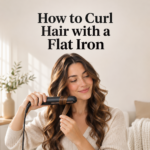
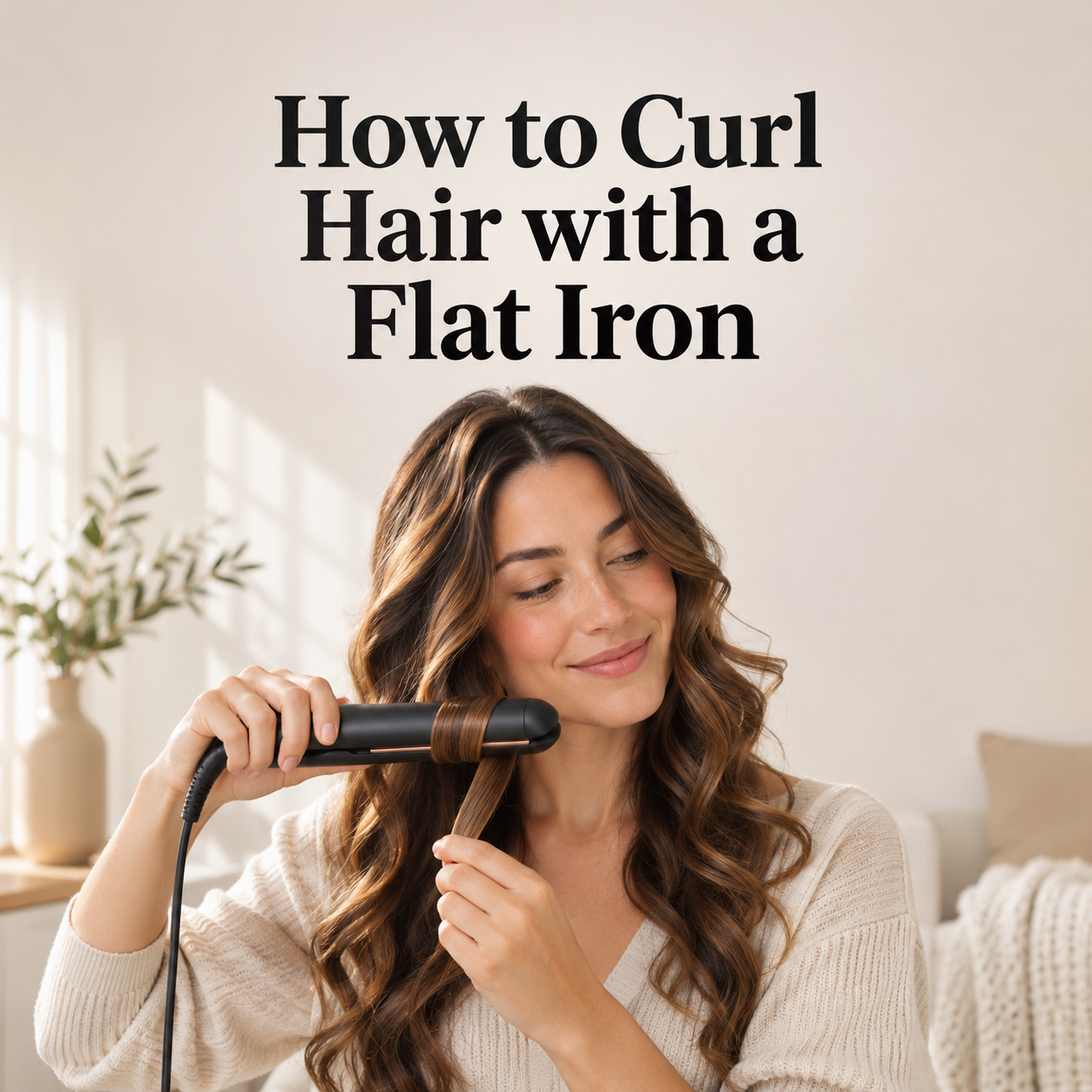

Yes, you can curl your hair with a flat iron, and for many people it works better than a traditional curling iron. A flat iron is slim, easy to control and already sitting in your drawer. Once you learn one simple wrist movement, the same tool that makes your hair sleek and straight can also give you soft beach waves, bouncy curls or defined spirals.
This guide walks you through everything: which flat iron to choose, the right temperature for your hair type, the exact steps for four different curl styles, how to make the curls last, and how to protect your hair from heat damage. If you have never curled your hair with a straightener before, you will be able to do it confidently by the end.
Quick answer: Start with dry, heat-protected hair. Take a 1-inch (2.5 cm) section, clamp the flat iron about an inch below the root, turn the iron a half turn (180°), then glide it slowly down the hair in 3 to 5 seconds. Let the curl cool, repeat on every section, then loosen the curls with your fingers and set them with a light hairspray.
Can You Really Curl Hair with a Flat Iron?
You can. The reason it works is that a flat iron heats the hair evenly while the plates bend the strand as you rotate and pull it through. Hair is shaped by heat: when the strand is warm it is flexible, and when it cools in a bent position it holds that shape. A curling iron wraps the hair around a barrel, while a flat iron bends it around the rounded edge of the plate, which creates a softer, more natural-looking curl.
Flat Iron Curls vs. Curling Iron Curls
- Look: Flat iron curls look looser and more modern, with a slight bend rather than a perfectly uniform ringlet.
- Versatility: One tool can straighten, wave and curl, which is handy for travel and small bathrooms.
- Learning curve: The wrist movement feels strange for the first two or three sections, then becomes automatic.
- Tight ringlets: If you want very small, tight, identical coils, a thin curling wand is still the easier tool. A flat iron can do it, but it takes more practice.
What You Need Before You Start
Gathering your tools first keeps the process fast and keeps your hair safe. You only need six things.

- A flat iron with rounded plate edges and adjustable temperature (see the buying checklist below).
- A heat protectant spray, serum or cream. Never apply heat to unprotected hair.
- Sectioning clips to keep the rest of your hair out of the way.
- A fine-tooth comb to smooth each section before it goes into the iron.
- A flexible-hold hairspray to set the curls once they have cooled.
- A heat-resistant glove (optional), which is useful for the wrap technique described later.
How to Choose the Best Flat Iron for Curling
Not every straightener curls well. If you are buying a new one, or deciding whether the one you own is suitable, check these features.
| Feature | What to look for | Why it matters for curls |
|---|---|---|
| Plate width | 1 to 1.25 inches (2.5 to 3.2 cm) for most people | Slim plates bend the hair into a curl and move easily around the head. Wide plates are better for straightening and make bigger, looser waves. |
| Plate edges | Rounded or slightly beveled | Square edges leave creases and kinks. Rounded edges let the hair glide and curve. |
| Plate material | Ceramic, tourmaline-infused ceramic or titanium | Smooth plates distribute heat evenly. Titanium heats fast and suits thick hair, while ceramic is gentler on fine hair. |
| Temperature control | Adjustable settings with a clear display | You can match the heat to your hair type instead of guessing. |
| Floating plates | Spring-loaded plates | They apply gentle, even pressure, so the hair is not crushed. |
| Safety features | Auto shut-off and a swivel cord | The cord rotates with your wrist, and the iron turns itself off if you forget it. |
Very thick or very long hair may prefer a slightly wider plate, up to 1.5 inches (3.8 cm), because it speeds up the process. For short hair or bangs, a 0.75 to 1 inch plate gives better control.
The Right Temperature for Your Hair Type
Heat is what shapes the curl, but too much heat is what damages the hair. A higher temperature does not make a curl last longer. It mostly increases the risk of dryness and breakage. Begin at the low end of the range for your hair type and raise it by about 10 to 15 degrees only if the curl falls out too quickly.

| Hair type | Temperature (°F) | Temperature (°C) |
|---|---|---|
| Fine, thin, bleached or color-treated | 250 to 300°F | 120 to 150°C |
| Normal or medium texture | 300 to 350°F | 150 to 175°C |
| Thick, coarse or hard to curl | 350 to 400°F | 175 to 200°C |
Important: Avoid going above 400°F (about 200°C). If your hair is heavily damaged, bleached or very fragile, stay at the bottom of the range or below it and use fewer passes.
How to Prepare Your Hair
Good curls are 50 percent preparation. Skipping these steps is the main reason curls look flat or fall out within an hour.
- Start with completely dry hair. Never use a flat iron on damp hair. The water turns to steam inside the strand, which can cause serious damage and also stops the curl from setting. If you hear a hissing or sizzling sound, stop and dry the hair fully.
- Use a heat protectant. Spray it evenly from roots to ends and comb it through. Wait a minute for it to dry before heating.
- Detangle thoroughly. Knots cause uneven curls and snag in the plates.
- Avoid heavy oils and rich butters right before curling. They can weigh the hair down and make curls drop. Light serums are fine.
- Section the hair. For medium hair, divide it into 3 or 4 sections. For thick hair, use 5 or 6. Clip the top sections out of the way and begin at the bottom layer near the nape of the neck.
Hair that is one day old often holds curls better than freshly washed, very silky hair, because it has a little natural grip. If your hair is very slippery, a light texturizing spray before curling helps.
How to Curl Hair with a Flat Iron: Step by Step
This is the classic rotation method, the most popular way to curl hair with a flat iron. It creates smooth, bouncy curls from mid-length to the ends.

Step 1: Take a Small Section
Pick up a section about 1 inch (2.5 cm) wide. Smaller sections give tighter, longer-lasting curls, while larger sections give loose waves. Comb it smooth so there are no tangles.
Step 2: Clamp the Iron Below the Root
Hold the flat iron with the plates pointing down and clamp the section about 1 inch (2.5 cm) from the scalp. Leaving that gap keeps the hot plates away from your skin and avoids a harsh bend at the roots. Close the plates with gentle pressure. Do not squeeze hard.
Step 3: Rotate the Iron 180 Degrees
Turn your wrist so the iron makes a half turn and the plates now face upward. The hair wraps around the outside of the plate. For a natural look, rotate the iron away from your face on the front sections and in a consistent direction on the back.
Step 4: Glide Down Slowly
Keeping the iron turned, slide it down the length of the hair smoothly and without stopping. It should take about 3 to 5 seconds. If you move too quickly, the curl will be weak. If you stop, you risk a crease or burn. As you reach the ends, you can release the strand to let it curl naturally.
Step 5: Let the Curl Cool
Do not touch or brush the curl while it is warm. As the hair cools it locks into shape. If you have time, gently coil each curl around your finger and pin it to cool for even more hold.
Step 6: Repeat on the Whole Head
Work upward section by section, releasing a new layer each time. Alternate directions (one curl toward the face, the next away) if you want a more relaxed, natural look. Keep all curls turned the same way for a polished, uniform finish.
Step 7: Finish the Style
Once all the curls are cool, run your fingers through them to loosen and blend them. For softer waves, use a wide-tooth comb on the lengths only. Mist a light-hold hairspray from arm’s length and, if you like, add a drop of lightweight shine serum to the ends.
Three More Ways to Curl with a Flat Iron

1. Beach Waves (Twist Method)
Take a 2-inch (5 cm) section and twist it loosely into a rope. Slide the flat iron slowly down the twisted section from top to bottom, leaving the last inch (2.5 cm) out for a relaxed, tousled end. Let it cool before you release the twist. This is the fastest method and gives loose, effortless waves.
2. Spiral Curls (Wrap Method)
Take a thin section, about 0.5 to 1 inch (1.5 to 2.5 cm) wide, and twist it slightly. Close the flat iron and wrap the section around the outside of the closed plates in a spiral, from the root to the tip. Hold it for about 5 to 10 seconds, then slowly unwind. Wear a heat-resistant glove and keep the hair away from your skin. This method creates defined, tighter spirals.
3. S-Waves (Crimp-Free Bend)
For a retro, glam look, clamp a section near the root and bend the iron slightly forward, then glide it down while changing the angle, so the hair forms soft S-shapes. It works best on shoulder-length hair with a bit of body.
Which Method Should You Choose?
| Style | Best plate size | Difficulty | Time (medium hair) |
|---|---|---|---|
| Beach waves (twist) | 1.25 to 1.5 inches (3.2 to 3.8 cm) | Easy | 10 to 15 minutes |
| Bouncy curls (rotation) | 1 inch (2.5 cm) | Medium | 20 to 30 minutes |
| Spiral ringlets (wrap) | 0.75 to 1 inch (2 to 2.5 cm) | Hard | 30 to 40 minutes |
| S-waves | 1 to 1.25 inches (2.5 to 3.2 cm) | Medium | 15 to 25 minutes |
Curling Tips for Different Hair Types and Lengths
Fine or Thin Hair
Use the lowest temperature in the range and small sections. Fine hair heats quickly, so it can take a curl with less heat. A light mousse or volumizing spray before styling adds grip without weight.
Thick or Coarse Hair
Work in thinner sections and use more of them. Thick hair takes longer to heat through, so a higher setting in the recommended range may help. Take your time and do not overload the plates.
Straight, Slippery Hair
This hair type often loses curls quickly. Use a texturizing or grip spray, choose a smaller section, and make sure each curl cools completely before you move on.
Naturally Wavy or Curly Hair
You can use a flat iron to refresh or redefine curls, even them out or add a bend to sections that are straight. Use low heat and make sure the hair is perfectly dry, because textured hair is often more prone to dryness.
Short Hair and Bobs
Choose a slim 0.75 to 1 inch iron and curl only from mid-length to the ends. Rotating the iron 180° and releasing early gives you turned-under or flicked-out ends, depending on your direction.
Long Hair
Start the curl at chin or shoulder level instead of near the roots. Long hair has more weight, so it pulls the curl down. Use smaller sections and a stronger finishing spray to keep the shape.
How to Make Flat Iron Curls Last Longer
If your curls fall within an hour, the problem is usually not the iron. It is something small in the prep or the aftercare. Try these habits.

- Cool before touching. The curl sets as it cools, so brushing a warm curl pulls it straight.
- Use a light layer of hairspray at the end, not before. Spraying too much before heat can leave residue on the plates.
- Do not brush the curls. Use your fingers or a wide-tooth comb on the lengths only.
- Keep your hands away from your hair during the day. Constant touching loosens curls.
- Sleep smart. Loosely gather the hair into a high, soft ponytail or use a silk scrunchie. A silk or satin pillowcase reduces friction and frizz.
- Refresh the next day with dry shampoo at the roots and a quick pass on any sections that have dropped.
Common Mistakes to Avoid
- Curling damp hair. This is the quickest way to damage the strand and ruin the curl.
- Skipping heat protectant. Even low heat can dry out unprotected hair over time.
- Using sections that are too big. The outer hair gets hot but the inner hair stays straight, so the curl looks uneven.
- Holding the iron still. Always keep it moving. Staying in one place causes creases and burn marks.
- Pressing too hard. Heavy pressure flattens the hair and leaves a mark where the plates closed.
- Setting the temperature too high. More heat does not equal a stronger curl.
- Going over the same section repeatedly. One slow, even pass is better than three fast ones.
Troubleshooting: Fix Common Curling Problems
| Problem | Likely cause | What to do |
|---|---|---|
| Curls fall out quickly | Section too large, hair not cool, or hair too silky | Use smaller sections, let each curl cool and add a light texturizing product before styling. |
| Creases or kinks | Stopping mid-way or pressing too hard | Glide steadily and reduce pressure. Check that the plate edges are rounded. |
| Frizzy curls | Brushing, dry hair, or humidity | Use your fingers, add a drop of lightweight serum and a humidity-resistant finishing spray. |
| Curls look stiff or crunchy | Too much product | Use less spray, applied from a distance, and gently scrunch to soften. |
| Curl only forms at the ends | Rotating too late or sliding too fast | Start the rotation near the roots and slow your glide to 4 to 5 seconds. |
| Burning smell or sizzling | Damp hair or product build-up on plates | Stop at once. Dry the hair completely and wipe the cooled plates clean. |
Protect Your Hair from Heat Damage
Using a flat iron for curls is safe when it is done carefully, but regular heat styling will wear down the hair over time if you do not look after it.
- Limit how often you use heat. Aim for a few times a week at most, and give your hair rest days.
- Always use a heat protectant. Apply it on dry hair and let it settle before the iron touches it.
- Deep condition regularly. A weekly mask or leave-in conditioner replaces moisture that heat removes.
- Trim split ends. Heat can make existing splits travel higher, so a trim every 8 to 12 weeks keeps curls looking healthy.
- Use the lowest effective temperature. Make small adjustments rather than jumping to the highest setting.
- Air dry when you can. Letting hair dry naturally before styling reduces total heat exposure.
Watch for warning signs such as a rough or straw-like texture, white dots at the ends, or hair that will not hold a curl at all. These suggest it is time for a heat break and some extra conditioning.
Flat Iron Safety Tips
- Place the iron on a heat-resistant surface or in a heat-proof pouch while it cools. Never leave it on a bed, towel or carpet.
- Keep the plates away from your scalp, ears, neck and fingers. Use a comb to hold the hair when working close to the roots.
- Unplug the iron when you finish, even if it has an auto shut-off feature.
- Keep the cord away from water and do not use the iron in a damp or wet bathroom.
- Keep it out of reach of children and pets until it has cooled completely.
Frequently Asked Questions
What size flat iron is best for curling hair?
A flat iron with 1 to 1.25 inch (2.5 to 3.2 cm) plates is the best all-round size. It is slim enough to bend the hair into a curl and wide enough to cover a section quickly. Choose a thinner iron for short hair and tight curls and a wider one for long, thick hair and loose waves.
Can any flat iron curl hair?
Most flat irons can, but results are best with rounded plate edges and adjustable heat. Irons with sharp square edges tend to leave dents or creases, and very wide plates are harder to rotate smoothly.
What temperature should I use to curl hair with a flat iron?
Use 250 to 300°F (120 to 150°C) for fine or damaged hair, 300 to 350°F (150 to 175°C) for normal hair and 350 to 400°F (175 to 200°C) for thick or coarse hair. Always start at the lower end of your range.
Can I curl damp hair with a flat iron?
No. Damp hair should never be used with a flat iron. The moisture turns to steam and can damage the hair, and the curl will not set properly. Let your hair dry completely first.
How long do flat iron curls last?
With good prep and a light finishing spray, curls can last one to two days. Fine, straight hair may lose its shape sooner, while thick or slightly wavy hair holds curls longer.
Does curling with a flat iron damage hair?
Any heat styling can dry the hair if it is done too often, at a high temperature or without protection. Using a heat protectant, a moderate temperature, moving steadily and conditioning regularly keeps the risk low.
Why won’t my hair hold a curl?
The most common reasons are sections that are too thick, a temperature that is too low, curls touched before they cool, or heavy products that weigh the hair down. Try smaller sections and let each curl cool fully before you release it.
Final Thoughts
Curling your hair with a flat iron comes down to a few repeatable habits: dry hair, a heat protectant, small sections, a steady half-turn and a slow glide. Pick the technique that suits the look you want, match the temperature to your hair type, and let every curl cool before you touch it. With a little practice, you will be able to create beach waves, bouncy curls or defined spirals in under 30 minutes using just one tool.
If you are shopping for a new flat iron, look for slim rounded plates, adjustable temperature and smooth ceramic or tourmaline surfaces. They make curling easier and are gentler on your hair.