
If your hair never seems to get properly wet, or if it soaks up water and then turns dry and frizzy within hours, porosity is probably part of the story. Hair porosity is one of the most useful and most overlooked ideas in hair care, because it explains why the same product can work beautifully for one person and fail completely for another.
This guide explains what low porosity and high porosity hair really are, how they differ, how to work out which one you have, and how to adjust your routine, products and habits for each. It also covers the common mistakes that keep people stuck with hair that will not hold moisture.
What is hair porosity?
Hair porosity is a measure of how easily your hair absorbs and keeps moisture. It depends on the outer layer of each strand, called the cuticle. The cuticle is made of tiny overlapping scales, a bit like roof tiles or the scales of a pinecone. When the scales lie flat, moisture has a hard time getting in. When they are lifted or chipped, moisture enters easily but also escapes just as easily.

Porosity is usually grouped into three levels: low, medium and high. Medium porosity sits in the middle and tends to be the easiest to manage, because it absorbs and holds moisture in a balanced way. This article focuses on the two ends of the spectrum, since they are the ones that cause the most confusion.

What is low porosity hair?
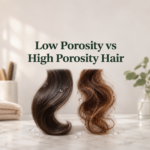
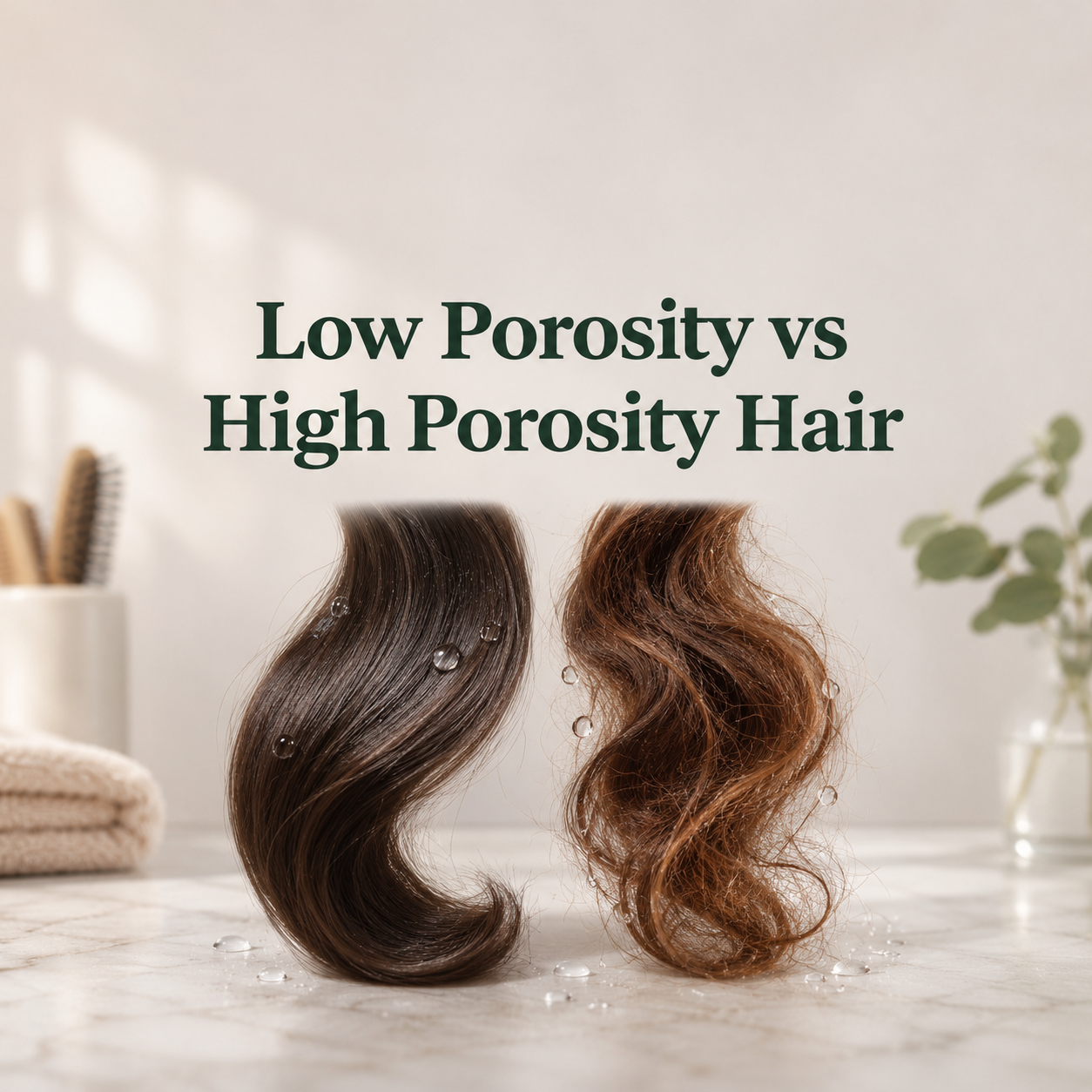
Low porosity hair has a tightly packed cuticle with scales that lie very flat. This gives the hair a smooth, shiny surface and protects it well from damage, but it also makes it hard for water, conditioner and treatments to penetrate.
Signs of low porosity hair
- Water tends to bead up on the hair instead of soaking in right away.
- Hair takes a long time to get fully wet in the shower.
- Hair takes a very long time to air dry.
- Products seem to sit on top of the hair and feel greasy, heavy or sticky.
- Hair gets coated or limp easily, especially with butters and thick oils.
- Deep conditioners seem to do little unless heat is used.
- Hair often looks shiny and smooth when it is clean.
What causes low porosity?
Low porosity is most often genetic. It is simply how your cuticle is built. Build-up from silicones, waxes, heavy butters and hard water minerals can also make hair behave as if it were lower in porosity than it really is, because a layer of residue blocks moisture from getting in.
What is high porosity hair?
High porosity hair has a cuticle that is raised, gapped or worn down. Moisture enters very quickly, which can feel great at first, but it leaves just as fast. As a result, high porosity hair tends to feel dry, rough and frizzy even when you condition it regularly.
Signs of high porosity hair
- Hair soaks up water almost instantly and feels very wet and heavy in the shower.
- Hair dries quickly, often in a short time after washing.
- Frizz appears easily, especially in humid weather.
- Hair tangles and knots often.
- Products absorb fast and seem to disappear within hours.
- Hair feels rough or straw-like, and ends may split often.
- Color may fade or change faster than expected.
What causes high porosity?
Some people are born with naturally high porosity hair. More often, high porosity develops over time from damage. Common causes include bleaching, repeated coloring, chemical relaxers and perms, frequent high heat styling, harsh shampoos, sun and chlorine exposure, and rough brushing or towel drying. Hair that has been damaged in this way will usually be more porous at the ends, which are the oldest part of the strand.
Low porosity vs high porosity hair: side-by-side comparison
| Feature | Low porosity | High porosity |
|---|---|---|
| Water absorption | Slow; water beads up or sits on the surface | Fast; hair soaks up water quickly |
| Drying time | Long; stays wet for ages | Short; dries quickly, often frizzy |
| Product behavior | Products sit on top and feel greasy | Products absorb fast and wear off |
| Common frustration | Build-up, stiffness, limp or coated hair | Dryness, frizz, tangles, breakage |
| Typical cause | Mostly genetic | Genetics, heat, bleach, dye, rough handling |
| Dye and treatments | Slow to take color | Takes color fast but may fade quickly |
| Best product weight | Light | Medium to rich |
| Protein needs | Low; easy to overdo | Higher; helps patch the cuticle |
The key idea
Low porosity hair struggles to let moisture in. High porosity hair struggles to keep moisture in. The solutions are different, and using the wrong one is why many routines fail.
How to test your hair porosity at home
You do not need a lab to get a good idea of your porosity. These simple tests are popular, and using more than one gives you a more reliable picture.
1. The float test
Take a few clean strands of shed hair from your brush, with no product on them. Drop them into a glass of room temperature water and wait several minutes. Hair that floats for a long time suggests low porosity. Hair that sinks slowly suggests medium porosity. Hair that sinks quickly suggests high porosity.

A fair warning about the float test
Many hair professionals consider this test unreliable on its own. Oils, residue and surface tension can keep a strand afloat even when the cuticle is open. Treat it as a hint, then confirm with the tests below.
2. The spray bottle test
Take a clean, dry section of hair and spray it lightly with water. If the droplets sit on the surface and bead up, your hair is likely low porosity. If the hair absorbs the water within a few seconds, it is likely medium or high porosity.
3. The slip-and-slide test
Take a single clean strand and slide your fingers from the end up toward the root. If it feels smooth, the cuticle is lying flat, which points to low porosity. If it feels bumpy or rough, the cuticle is raised, which points to high porosity.
4. Watch how your hair behaves
Over a few weeks, notice how long your hair takes to dry, whether products sit on top or vanish, and how it feels a day after washing. Real-life behavior is often a better guide than any one-time test.
How to care for low porosity hair
The goal with low porosity hair is to help moisture get past the tight cuticle without weighing the hair down.
- Apply products to damp, warm hair. Warm hair lets the cuticle relax a little. A warm towel or a steamer during deep conditioning can help products absorb.
- Choose lightweight products. Water-based lotions, milks, mists and light gels usually work better than thick creams and butters.
- Use light humectants. Ingredients such as glycerin, aloe vera and honey draw water into the hair, but use them in moderation, especially in very dry or very humid climates.
- Clarify regularly. Build-up is the biggest enemy. A clarifying shampoo used occasionally clears residue so moisture can enter.
- Go easy on protein. Low porosity hair is already strong, and too much protein can make it stiff or brittle.
- Rinse well. Leftover conditioner or styler adds to the coating effect.
Ingredients that usually suit low porosity hair
Look for lighter oils such as argan, grapeseed, jojoba and sweet almond, and ingredients like aloe vera, glycerin, panthenol and hydrolyzed proteins in small amounts. Heavy butters and thick oils are more likely to sit on the surface and feel weighty.
How to care for high porosity hair
The goal with high porosity hair is to fill in gaps, keep moisture in and protect the cuticle from further damage.
- Layer your moisture. A popular method is to apply a water-based leave-in, then a cream, then a sealing oil or butter. The sealant slows moisture loss.
- Use richer products. Butters such as shea and mango, and heavier oils like olive and castor, hold moisture in better.
- Add protein treatments from time to time. Protein can temporarily patch gaps in the cuticle. Alternate with moisture treatments so the hair stays flexible.
- Rinse with cool water. A cooler final rinse helps the cuticle lie flatter and adds shine.
- Reduce heat and chemical stress. Lower the temperature of hot tools, use a heat protectant, and space out coloring and chemical services.
- Handle gently. Detangle when hair is wet and conditioned, use a wide-tooth comb, and dry with a soft cotton shirt or microfiber towel instead of a rough towel.
- Protect at night. A satin bonnet or pillowcase reduces friction and moisture loss.
Ingredients that usually suit high porosity hair
Look for shea butter, mango butter, avocado oil, olive oil and castor oil, along with conditioning ingredients such as ceramides, amino acids and hydrolyzed proteins. Gentle, sulfate-free cleansers help prevent more dryness.

Common mistakes to avoid
- Using heavy products on low porosity hair. They sit on the surface and cause build-up and limpness.
- Skipping sealants on high porosity hair. Without something to lock moisture in, hydration disappears quickly.
- Relying on one test. Combine several tests with real-life observation.
- Treating the whole head the same. Roots and ends often need different care.
- Overusing protein or moisture. Balance matters. Too much of either can leave hair stiff or limp.
- Ignoring heat and chemical damage. Repeated damage is the main reason hair becomes high porosity.
- Skipping clarifying. Build-up can make any hair type feel low porosity.
What to look for when buying hair products
Product labels can be confusing, so it helps to know what to check. Whatever your porosity, read the ingredient list instead of relying on marketing claims.
- Weight and texture. Lotions, mists and gels are lighter. Creams, butters and balms are richer.
- Humectant level. Glycerin, honey and aloe attract water. They are helpful, but too much in a very dry or very humid climate can backfire.
- Protein content. Words like hydrolyzed wheat protein, keratin or silk amino acids indicate protein.
- Silicones and waxes. Heavy silicones and waxes may build up, especially on low porosity hair.
- Cleansing strength. Gentle cleansers suit high porosity hair. A clarifying shampoo is useful for occasional deep cleans.
Patch test new products, introduce one at a time, and give each a few weeks so you can see how your hair really responds.
Frequently asked questions
Can hair porosity change over time?
Yes. Your natural porosity is largely set by genetics, but heat styling, bleaching, coloring, chemical straightening, sun exposure and rough brushing can raise it. Gentle care and regular conditioning can make high porosity hair behave better, though a lifted or damaged cuticle does not fully repair itself.
Can I have low porosity roots and high porosity ends?
Absolutely. Newer growth is usually in its natural state, while ends have been exposed to months or years of washing, styling and weather. Many people need a lighter routine for the roots and a richer one for the ends.
Is low porosity hair healthier than high porosity hair?
Not necessarily. Porosity describes how hair handles moisture, not how healthy it is. Low porosity hair can be perfectly healthy but needs the right products to get moisture in. High porosity hair can be healthy too, especially when it is naturally that way.
How often should I wash each type?
There is no single schedule. Low porosity hair often benefits from regular washing with an occasional clarifying wash to remove build-up. High porosity hair usually does better with gentle cleansing and not stripping it too often. Scalp type, activity level and texture matter more than porosity alone.
Does porosity depend on curl pattern?
No. Straight, wavy, curly and coily hair can all be low, medium or high porosity. Curl pattern describes shape; porosity describes the cuticle.
Should I use protein treatments?
Protein can help high porosity hair by temporarily filling gaps in the cuticle. Low porosity hair is easier to over-protein, which can leave it stiff or brittle, so use it sparingly and watch how your hair responds.
Final thoughts
Low porosity and high porosity hair are not good or bad. They are simply two different ways hair handles moisture. Low porosity hair needs help getting moisture in, usually with warmth, light products and regular clarifying. High porosity hair needs help keeping moisture in, usually with layering, richer products, gentle handling and less damage.
Once you know where your hair sits on the spectrum, shopping and styling become far simpler. Start with a couple of tests, watch how your hair behaves, adjust your routine one step at a time, and be patient. Hair responds to consistent, suitable care, and small changes often make a surprisingly big difference.